
A simple, friction-free framework to cover your needs, fund your life, and build savings without counting every coffee.
In fifty years of working with technology and system design, I have learned one truth that never changes: if a system requires too much daily effort to maintain, people will abandon it.
It does not matter if it is enterprise software, a workshop workflow, or a personal budget. The moment the friction of running the tool becomes greater than the value it delivers, human nature takes over. We quit.
That is why most traditional budgets fail before the end of January. They ask you to turn into a low-paid data entry clerk for your own life. You are expected to log every four-dollar drip coffee, split groceries into three distinct sub-categories, and reconcile receipts on Sunday afternoon like an auditor looking for corporate fraud.
It is exhausting, and it is entirely unnecessary.
If you want to control your money, you do not need thirty line items. You need broad guardrails. That is where the 50/30/20 rule comes in.
Three Buckets, No Micromanagement
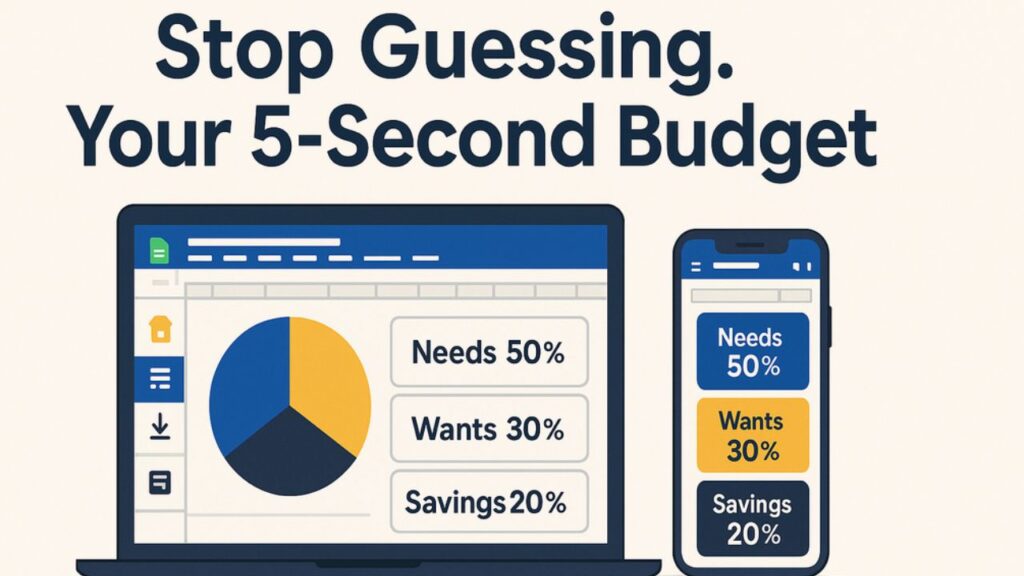
The 50/30/20 framework was popularized by Elizabeth Warren and her daughter, Amelia Warren Tyagi, in their book All Your Worth. The core idea is refreshing in its simplicity. Instead of tracking every nickel, you split your take-home pay—your actual net income after taxes—into three distinct buckets:
- 50% for Needs: The non-negotiables required to keep a roof over your head and the lights on. Housing, basic utilities, essential groceries, baseline transportation, and minimum debt payments. If you lost your job tomorrow, these are the bills you must pay to survive.
- 30% for Wants: Your life-enjoyment bucket. This is the money that makes working worthwhile, and under this system, you spend it without a single drop of guilt—whether it’s dining out, streaming services, travel, or hobbies.
- 20% for Savings and Debt Paydown: The money that buys your independence down the road. Emergency reserves, retirement contributions (beyond any match), investments, and extra principal payments on high-interest debt.
That is the entire blueprint. Three numbers. No micro-management required.
Why Guardrails Beat Micromanagement
When I design software or set up a business process, I look for single points of failure. In personal finance, the single point of failure is cognitive fatigue.
When a budget requires you to decide whether an iced latte belongs under “Dining Out,” “Groceries,” or “Miscellaneous Hobbies,” you force your brain to make hundreds of low-value decisions every month. By week three, you drop the habit entirely.
Broad guardrails solve this by eliminating decisions.
As long as your total “Wants” stay under thirty percent of your net income, it does not matter if you bought five coffees, two books, or a pair of boots. The individual line items are irrelevant because the overall bucket is constrained. You keep the main thing the main thing.
Lower the operational friction, and budgeting stops being a daily chore and becomes a simple monthly check-in.
Real-World Reality Checks
No framework fits every living situation perfectly out of the box. Life is messier than a clean formula.
If you live in a high-cost area—like New York, Seattle, or Chicago—housing alone might swallow forty percent of your paycheck. Add in utilities and groceries, and your “Needs” bucket might sit closer to sixty percent.
Does that mean the system failed? Not at all. It just means you deal with reality as it exists today.
If your essential bills take up sixty percent of your income, adapt the target temporarily. Move to a 60/20/20 distribution: sixty percent Needs, twenty percent Wants, and twenty percent Savings.
The goal isn’t mathematical perfection on day one. The goal is having an honest, simple benchmark so you know where your dollars go—and where to adjust over time.
How to Set It Up in 5 Minutes
You do not need a degree in finance or hours of free time to get this running.
- Find your net monthly income: Check your paystub for the actual dollar amount landing in your bank account after taxes and deductions.
- Calculate your three targets:
- Multiply net income by
0.50(Needs) - Multiply net income by
0.30(Wants) - Multiply net income by
0.20(Savings)
- Multiply net income by
- Automate savings first: Set up an automatic transfer on payday that moves that twenty percent directly into a separate savings or investment account. If the money leaves your checking account before you see it, you will never miss it.
- Live inside the boundaries: Pay fixed bills from main checking, use what remains for monthly wants, and stop worrying about counting pennies.
A Simple Tool to Keep You on Track
Managing your money doesn’t have to be hard, and you certainly don’t need a bloated, complicated system to stay in control.
If you want a dead-simple way to run this system without setting up formulas from scratch, I put together a minimal spreadsheet called the 5-Second Budget. It gives you clean, high-level guardrails without forcing you to log every coffee or spend hours managing a monster tool.
You can download it for free at 5 Second Budget Starter using the discount code FREE-INTRO at checkout.
Grab the spreadsheet, plug in your net income, set your guardrails, and get on with your life.