
Stop letting robotic product copy kill your store’s conversions. Here is how to inject human soul into your digital storefront using structured prompting.
Have you ever walked into a physical store, asked about a product, and had the clerk read the dry, technical specifications off the back of the box in a completely flat monotone?
Of course you have. And did you buy it? Probably not.
Yet, this is exactly what millions of e-commerce store owners do every single day on their websites. They copy and paste generic, robotic AI descriptions that read like a dry technical manual. I am here to tell you that dog simply won’t hunt.
If your digital copy sounds like an algorithm wrote it, your customers will run straight into the arms of your competitors. We need to turn your AI into your absolute best salesperson. Let’s open the hood and see how we can build a true conversion engine.
The Untuned Engine of E-Commerce
Unstructured AI is like an untuned carburetor on a classic truck. It spits, it sputters, it makes a massive amount of noise, and it wastes a ton of fuel. In the digital world, that wasted fuel is your hard-earned ad spend.
When you give an AI a lazy prompt like “write a product description for an ergonomic chair,” you get a lazy response. The AI defaults to its standard corporate vocabulary. It starts babbling about “revolutionary designs,” “synergistic comfort,” and “game-changing lumbar support.”
Does that sound like a real person to you?
To fix this, we have to stop treating AI like a magic mind-reader. We must treat it like a highly capable assistant who needs a clear, structured blueprint.
The 5-Part Prompting Blueprint
We do not borrow trouble by guessing what works. Instead, we rely on a repeatable, structured framework to get predictable, high-converting copy. As outlined in our Fix My Prompt PRO Guide, every single high-performing prompt requires five specific pillars to function:
- Role: Who should the AI act as? (e.g., A world-class direct-response copywriter).
- Task: What exactly do you want it to write? (e.g., A 150-word product description).
- Context: Who is the target audience and what are the key product benefits?
- Format: How should the final output look? (e.g., A bold hook, three bullet points, and a call-to-action).
- Constraints: What are the strict boundaries? (e.g., Avoid words like “revolutionary” or “game-changer,” and write at an 8th-grade reading level).
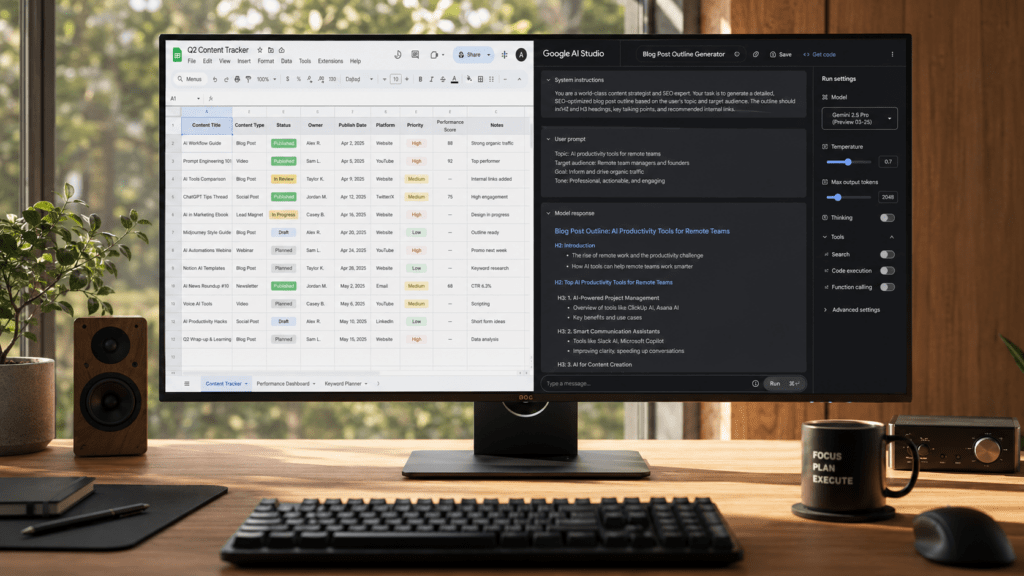
To keep my workflow simple, I manage all of these raw prompt variables inside a master tracker in Google Sheets. From there, I test and refine my models in Google AI Studio before pushing them live to my draft folder in Google Drive. This keeps our content ecosystem incredibly lean and organized.
The Forensic Comparison: Weak vs. Pro
Let’s look at a quick comparison to see how this structural shift plays out in the real world.
The Weak Prompt (The Silent Conversion Killer)
“Write a product description for our thermal camp mug.”
The result is always a wall of text filled with generic adjectives that nobody actually reads.
The Pro Prompt (The Conversion Engine)
By applying the standards from our Fix My Prompt PRO Guide, we restructure the request completely:
- ROLE: Senior conversion copywriter specializing in outdoor gear.
- TASK: Write a 100-word product description for a double-walled thermal camp mug.
- CONTEXT: Our audience consists of rugged, weekend-warrior campers who hate lukewarm coffee. The mug keeps coffee boiling hot for 12 hours.
- FORMAT: Start with a punchy, pain-point hook, followed by 3 short bullet points, and end with a direct call-to-action.
- CONSTRAINTS: Do not use the words “ultimate,” “revolutionary,” or “perfect.” Write with a warm, conversational, and direct tone.
Can you see the difference? The second approach doesn’t leave room for the AI to hallucinate or turn robotic. It forces the machine to speak directly to the customer’s desires.
Scaling Your Store’s Sales Engine
This operational shift is a core component of our Week 11 Strategy. If you read our Master Engineer Context Bridge for Week 11, you know that “money is just data with an attitude.”
We don’t write copy just to fill up white space on a webpage. We write copy to move data—specifically, to move dollars from your customer’s wallet into your merchant account.
If you are ready to stop guessing and start engineering your marketing copy for raw sales impact, you need a proven playbook.
Get the Blueprint to Stop Getting Generic AI Answers
Don’t let robotic copy hold your digital storefront back for another single day. Grab our Fix My Prompt PRO Guide for just $7. It is a complete, plug-and-play system featuring 25 highly structured, professional prompt templates designed to handle everything from product descriptions to direct-response marketing.